
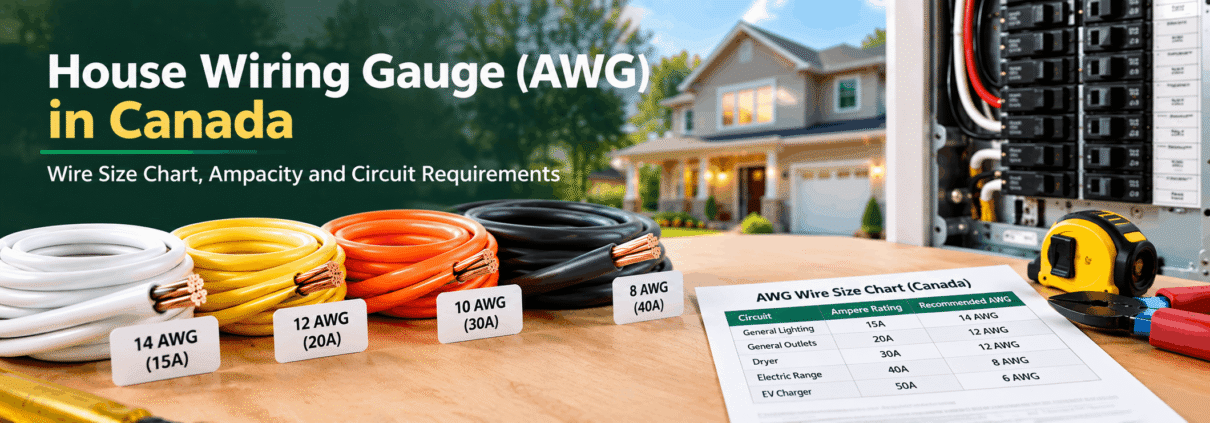
House Wiring Gauge (AWG) in Canada: Wire Size Chart
Understand common residential wire sizes, ampacity, circuit requirements and voltage-drop considerations for Canadian homes.
Proper wire sizing helps prevent overheating and supports safe operation of residential electrical circuits
Wire size must be selected according to applicable electrical code requirements, conductor ampacity, circuit conditions, and installation methods.
Longer wire runs can require additional consideration for voltage drop to help maintain proper circuit performance.
Canadian Residential Wiring: A Guide to Wire Gauge
Wire Gauge and the Canadian Electrical Code
The primary source for regulation of residential wiring in Canada is the Canadian Electrical Code (CEC) developed by the Canadian Standards Association (CSA). The CEC is revised every three years. Each province or territory in Canada has its electrical code based on the CEC, with potential amendments to the code for regional considerations (e.g., the BC Electrical Code).
The code creates minimum standards for safe wiring practices, effective grounding and bonding, and required overcurrent protection. Electrical wiring gauge (size) plays a major role in ensuring system safety and reliability, as the gauge of the wire is a determining factor in how much electrical current (ampacity) the conductor can safely carry.
Wire Gauge Requirements for Standard Circuits
For residential applications, the wire gauge must be rated for the rating of the protective breaker or fuse and the CEC Section 8 (Circuit Loading). CEC Rule 14-104 states that the rating of the overcurrent protective device doesn’t have to be equal to or greater than the ampacity of the conductors it is protecting.
- 15 A Circuits: Standard 15 A circuits would normally require a 14 AWG [American wire gauge] copper wire. The maximum allowed overcurrent protection for 14 AWG copper conductors is 15 A.
- 20 A Circuits: 20 A circuits (such as kitchen, bathroom and laundry) require a 12 AWG copper wire. The maximum allowed overcurrent protection for 12 AWG copper conductors is 20 A.
Using the wrong wire gauge can lead to overheating and a fire hazard. For very long runs (greater than 100 feet for a 20 A circuit), a larger wire size like 10 AWG wire may be required to reduce the voltage drop and get the voltage you need to the load.
Wiring for High-Power Loads (240V)
Circuits supplying major appliances like electric ranges and clothes dryers carry higher loads and necessitate larger conductors:
| Appliance | Common Breaker Size (Amps) | Common Copper Wire Gauge (AWG) |
Residential Electric Range | 40 Amps | 8 AWG |
Electric Clothes Dryer | 30 Amps | 10 AWG |
Electric Range: The typical installation of an electric range in a Canadian residence is by a 40 A breaker and typically uses 8 AWG copper wire.
Electric Dryer: The standard installation of a dryer is on a 30 A breaker, and generally, 10 AWG copper wire or an equivalent aluminium conductor applies. For larger dryers, i.e,. For high-powered residential needs or longer wire lengths runs, using 8 AWG or 6 AWG would be suggested for a load that requires they are capable of the load and voltage drop ampacity.
Types of Conductors and Temperature Restrictions
NMD90 is the most commonly used type of non-metallic sheathed cable for residential wiring in Canada. This cable contains annealed (soft) copper conductors with 90°C-rated PVC insulation and a nylon jacket. Hay also manufactures certified aluminium NMD90 for larger gauges (such as #8 AWG to #2 AWG).
Termination Temperature Limit: Although the wiring insulation is rated for use at 90°C, the CEC Rule 4-006 contains restrictions on the maximum termination temperature of the connection terminals to the equipment (breaker or fuse).
Where the maximum termination temperature is not shown on the equipment, for equipment rated less than or equal to 100 A or equipment marked for use with not more than 1 AWG conductors, a termination temperature limit of 60°C has to be used.
The 60°C termination temperature limit may result in a derated conductor ampacity, which may change the final wire gauge wire selection.
Requirements for Grounding and Bonding
Grounding and bonding are critical to protecting persons and property from the hazards posed by an electrical installation.
- Bonding: Bonding ensures that exposed metal parts of electrical equipment are all at the same potential and creates a low-impedance connection back to the source for fault currents.
- Grounding: Grounding is a practice that connects the bonded parts of the electrical system to the earth and stabilizes voltages.16 CEC Rule 10-210 requires that the grounded conductor of an AC system is connected to a grounding conductor at one point only: the consumer’s service.
- Size of Bonding Conductor: The size of the equipment bonding conductor is determined by the ampacity of the largest ungrounded (live) conductor in the system, generally referring to CEC Table 16.
Consequences of Not Following the Code
It is mandatory to comply with the CEC , and local electrical safety codes. If there has been non-compliance, especially with work that has not been permitted , or with wiring that is known to be outdated (e.g., ungrounded knob-and-tube), the homeowner may have their coverage denied, or they may have their premiums increased in the event of a fire caused by an electrical issue. Also, electrical work that is unpermitted or unsafely done could expose the homeowner to a legal liability, and/or fines from an electrical authority. Obtaining a permit and subsequently having a Certificate of Acceptance after the electrical work is inspected is how insurance companies can reassure themselves that the electrical work was done according to the code.
Special Consideration: Voltage Drop
The CEC mandates that wire size must increase for long distances (e.g., sheds, garages far from the main panel) to prevent voltage drop. Even if a circuit only pulls 20 Amps, a long run might necessitate 10 AWG wire instead of 12 AWG to maintain proper voltage.
Always calculate voltage drop before installation.Need Help With Your Home Wiring?
Planning new wiring, rewiring, or an electrical upgrade? Our team can help assess your residential electrical project and determine the appropriate electrical work.
Get an Electrical Quote View House Wiring ServicesRelated Electrical Services
Explore related electrical services for residential wiring, rewiring, electrical upgrades, and home safety.
House Wiring Services
Professional residential wiring services for new installations, renovations, and electrical upgrades.
View House Wiring Services →Rewiring an Old House
Learn about old-house rewiring, common wiring issues, safety considerations, and project planning.
Explore Rewiring Services →Fuse Box Replacement
Learn about replacing an outdated fuse box and the factors involved in residential electrical upgrades.
Learn About Fuse Box Replacement →Cost to Rewire a House
Explore the factors that affect residential rewiring costs, including house size, wiring condition, and project scope.
See Rewiring Costs →AWG Wire Size Chart for Canadian Residential Wiring
| AWG Gauge | Max Amperage (Current Limit) | Common Residential Use |
|---|---|---|
| 14 AWG | 15 Amps | General Lighting Circuits, Standard 15A receptacles |
| 12 AWG | 20 Amps | Kitchen/Bathroom Small Appliance Circuits |
| 10 AWG | 30 Amps | Selected dedicated loads |
| 8 AWG | 40 Amps | Selected dedicated loads |
| 6 AWG | 50 Amps | Selected high-demand loads |
social profile


Elsynergy Electrical Services
Canada – Ontario
Active
July 07, 2010
6-1500 Upper Middle Rd W, Oakville, ON, L6M OC2 PMB # 326
(+1)6478326545
Office Hours
Whenever You Need Us “24/7”